Simultaneous translation will be available during Didier Queloz’s sessions.
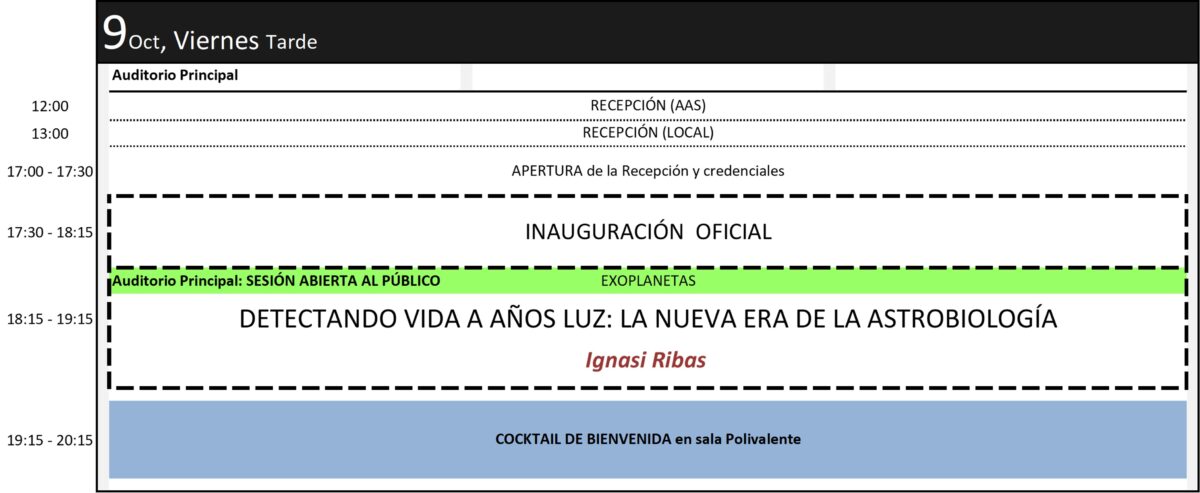
- Inaugural conference open to the public.
- Scientific sessions on astrophysics, heliophysics, exoplanets, observation, astrometry, photometry, spectroscopy, and others currently in preparation.
- National astrophotography and astronomical drawing competition.
- Exhibition of observation instrumentation and outreach materials.
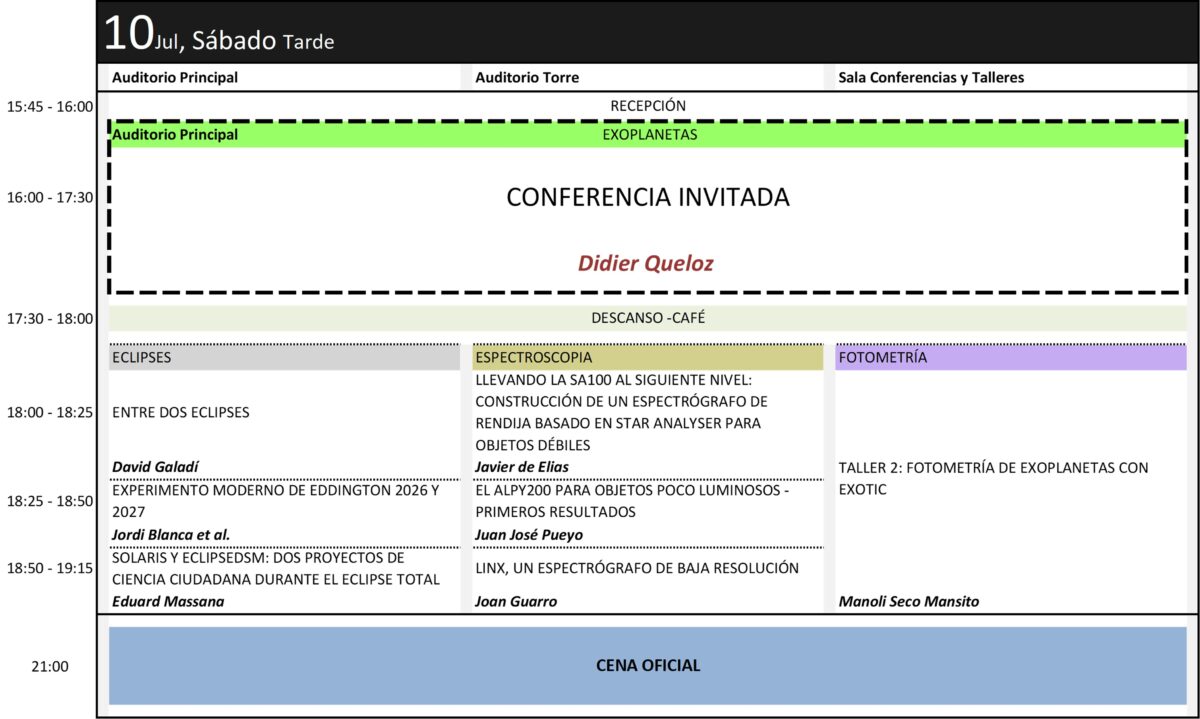
- Official Congress Dinner.
- Guided tour of the Sabadell Observatory.
- Guided tours of the city of Sabadell.
- CEA ASTROPHOTOGRAPHY AND ASTRONOMICAL DRAWING CONTEST
Open exclusively to registered participants who are members of any Astronomical Association or Astronomy Club in Spain. Rules and guidelines with all the details for participation.
Why participate?
Sharing your achievements after so much effort to capture the perfect image of the wonders the Universe offers us truly deserves a chance to be recognized.
Take advantage of the wide range of categories to submit your best works.
6 categories, each with a First and Second Prize: Deep Sky, Planetary, Astrolandscape, Astronomical Time-Lapse/Video, Classical Astronomical Drawing, and Astronomical Art.
Submit your photos and creations by 13 September via email to:
concursos.CEA@astrosabadell.org
Collaborators:
Prof. Dr. DIDIER QUELOZ
2019 NOBEL PRIZE IN PHYSICS
With us in Sabadell, 2019 Nobel Prize in Physics laureate for the discovery of the first exoplanet, 51 Pegasi b, orbiting a Sun-like star.
KEYNOTE LECTURE
Saturday, October 10, at 4:00 p.m.
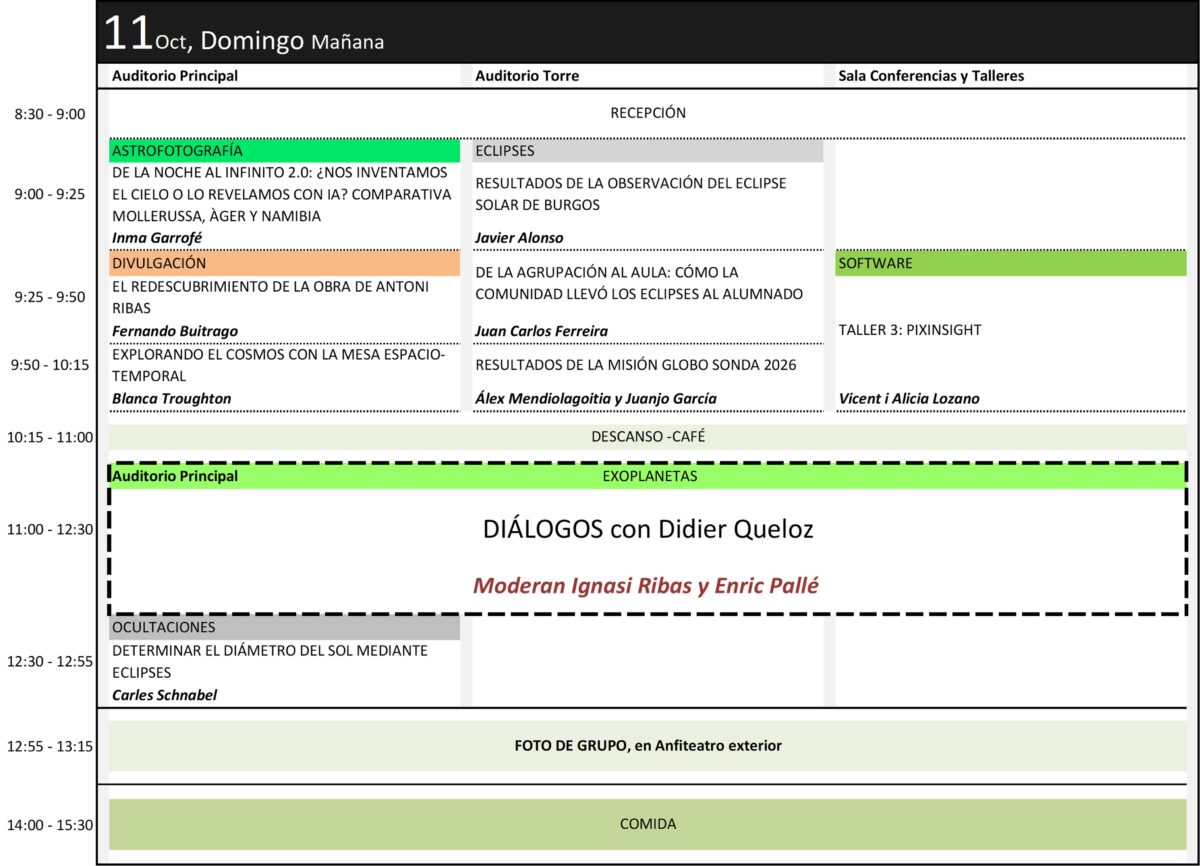
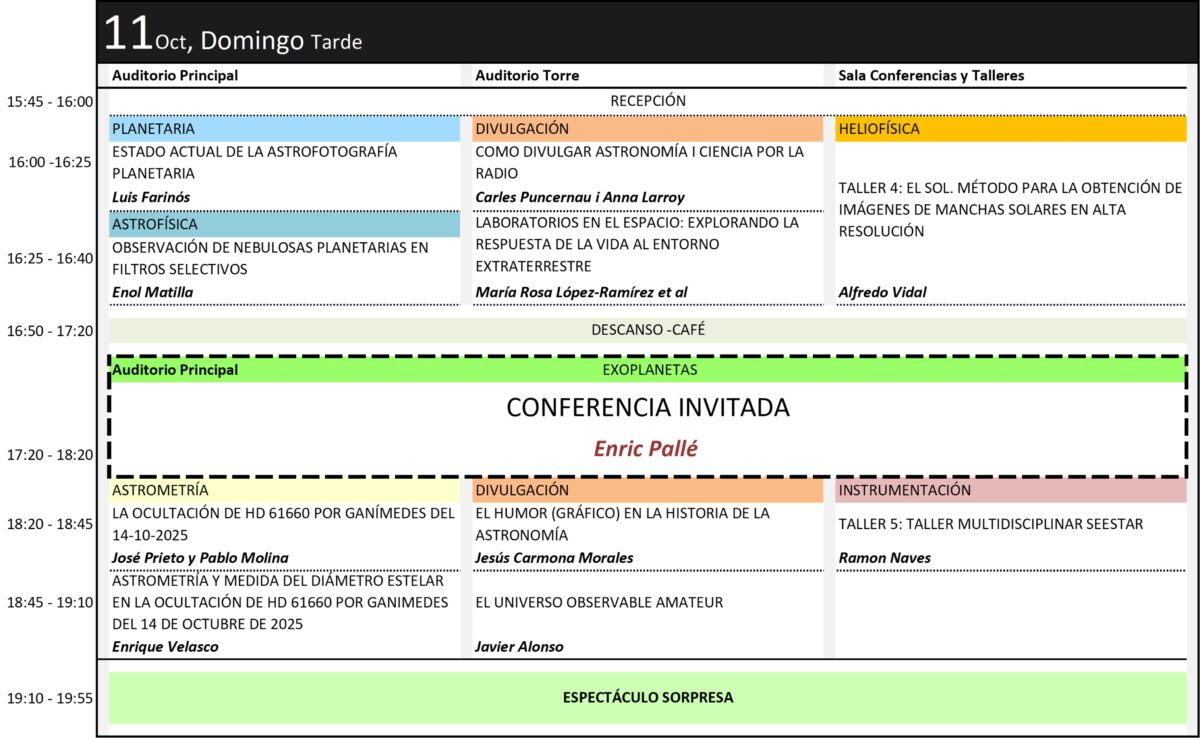
PANEL DISCUSSION & DIALOGUE
Sunday, October 11, at 12:00 p.m.
Dr. Queloz built his scientific career at the University of Geneva, where, in 1995, while completing his PhD under the supervision of Dr. Michel Mayor, he announced the discovery of 51 Pegasi b, the first planet detected outside our Solar System orbiting a Sun-like star.
While searching for brown dwarfs, Michel Mayor and Didier Queloz detected a signal in their radial velocity measurements. Rather than dismissing it, they chose to investigate it thoroughly. By developing new detection techniques and adopting an innovative approach, they provided the first compelling evidence for the existence of planets beyond our Solar System, with characteristics that had been considered unimaginable until then.
Prof. Queloz’s discoveries and the methodology he developed have been fundamental to modern astronomy, laying the foundations of the so-called “Exoplanet Revolution.” His work transformed our understanding of planetary formation and the Earth’s place in the Universe, achievements that led to his being awarded the 2019 Nobel Prize in Physic
Prof. Queloz is currently Professor at the Cavendish Laboratory, University of Cambridge, and Professor of Physics at ETH Zurich.
For all these reasons, we would like to express our sincere gratitude to Prof. Didier Queloz for honoring us with his presence in Sabadell and for sharing his knowledge and insights with us.

Ignasi Ribas
OPENING LECTURE
Friday, October 9 at 6:30 PM
He holds a PhD in Physics from the University of Barcelona and is currently a Research Professor at the Institute of Space Sciences (CSIC).
His research focuses on the discovery and characterization of exoplanets, particularly those similar to Earth, with the aim of searching for life in the future. He holds leading responsibilities in the development of astronomical instruments and in several space missions, including CHEOPS, PLATO, and Ariel. She also coordinates the development of nanosatellite projects.

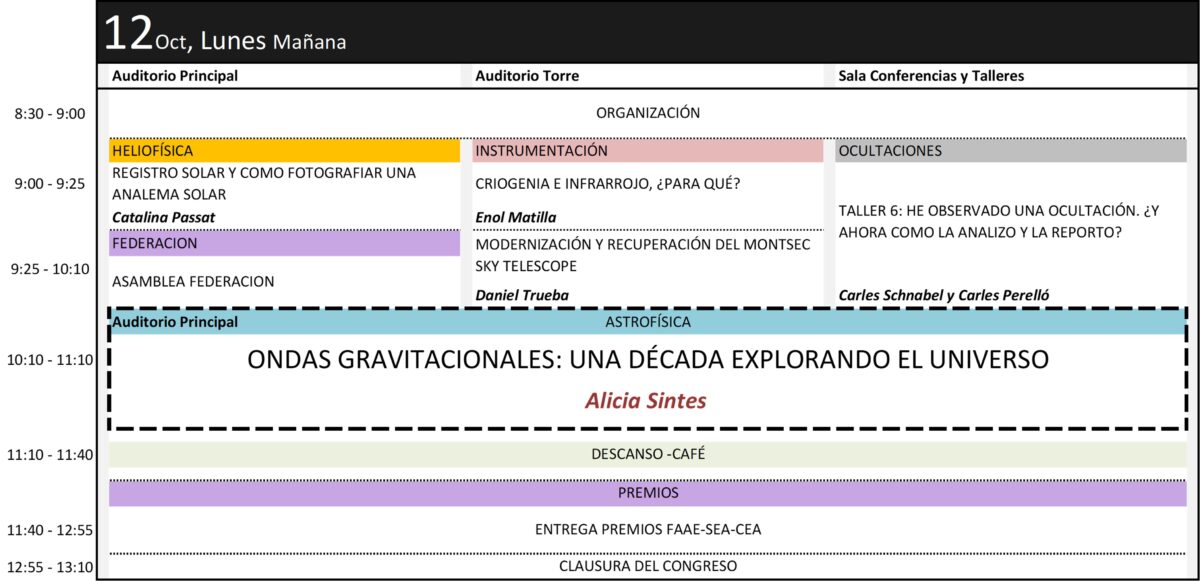
Alicia Sintes
CLOSING CONFERENCE
Monday, October 12 at 09:45 AM
Professor of Theoretical Physics at the University of the Balearic Islands and an international leading figure in gravitational-wave astronomy. She is the principal investigator of the GRAVITY group and director of the Institute for Computational Applications of Community Code. She holds a PhD from the University of the Balearic Islands and developed part of her career at the Max Planck Institute for Gravitational Physics. She has been involved in the LIGO collaboration since its early days. She is currently a member of the LISA Consortium and the Einstein Telescope project.

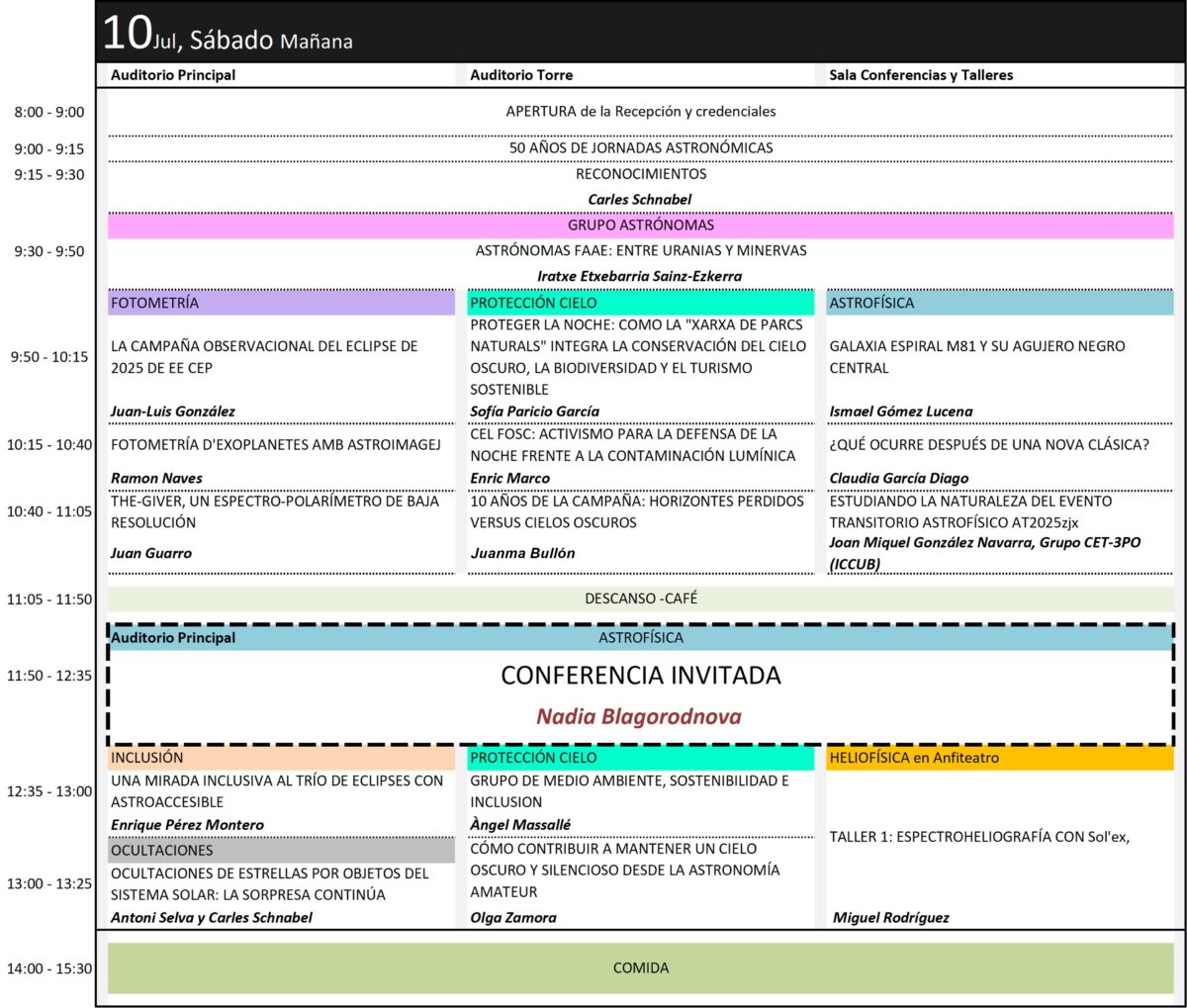
NADIA BLAGORODNOVA
INVITED LECTURE
Saturday, October 10 (morning)
She is a professor at the Faculty of Physics of the University of Barcelona. Her research focuses on observational time-domain astronomy, which studies transient astrophysical phenomena such as supernovae, stellar mergers, and stars torn apart by supermassive black holes. With the research group Common Envelope Transients – Progenitors, Precursors, and Properties of their Outbursts (CET-3PO), funded by a grant from the European Research Council (ERC), she studies the interaction and merger of close binary stars.
She has been jointly recognized with the National Research Award for Young Talent 2025.

Enric Pallé
PhD in Astrophysics from Armagh Observatory/Queen’s University Belfast. He completed the first cycle of his Physics degree at the Autonomous University of Barcelona and obtained his bachelor’s degree at the University of La Laguna in the Canary Islands. He has extensive professional experience, beginning as a Postdoctoral Researcher at the New Jersey Institute of Technology & California Institute of Technology in the United States. He has been a Ramón y Cajal Fellow at the Instituto de Astrofísica de Canarias, Head of the Research Department, and currently holds the highest-level position as a Research Professor at the same institute. His research focuses on three main areas: studying Earth as a planet from space to identify biosignatures in its global light; analyzing exoplanet atmospheres through transmission spectroscopy (particularly using the 10-meter GTC telescope); and detecting and confirming exoplanets using telescopes such as Kepler (K2) and SuperWASP.
The official language of the congress is Spanish. Simultaneous interpretation into Spanish will be provided for invited conferences delivered in English.